This is a cross-post from Human Rights in Ireland about the marriage equality referendum which will be held in Ireland on May 22.
Over the last few weeks, campaigning on Ireland’s marriage equality referendum has been taking place in earnest. While the ‘yes’ side entered the formal referendum campaign with a steady lead in the polls and has long been well organised, the ‘no’ side has emerged rapidly and, in some ways, chaotically, scoring successes along the way (for example, through amendment of the proposed Irish language text).
The ‘no’ campaign has certainly been gaining traction. This is not unusual in constitutional referenda, when the burden of establishing that the status quo ought to be changed lies firmly with the ‘yes’ campaign, as it should do. In some ways, the ‘no’ campaign may seem unstructured, disorganised and ad hoc; after all, it has no particular supra-structure to shape it as all major political parties support the referendum (which in itself is not at all unusual) and the Irish Association of Catholic Priests has elected to take a neutral position. Furthermore, the ‘no’ side seems to comprise everything from prolific letter writers, to the Iona Institute, to Bruce Arnold sending ‘private study papers’ (which appears to more or less be a structured ‘letter’) to members of the Oireachtas, all raising such a range of arguments that they are difficult to address in a coherent way. These arguments include everything from the utter canard of assisted human reproduction and surrogacy (excellently dismissed by Conor O’Mahony here), to the bizarre suggestion that somehow children raised by married same-sex parents will not have grandmothers. However, in my view, the campaign against marriage equality—and the infrequently-articulated ‘real’ concern in many people’s minds—is not about children, or family, or even marriage; it is about the ‘specialness’ of heterosexuality.
Marriage is now pretty much the only thing that is ‘special’ about heterosexuality; it is the only institution from which the state expressly excludes people who are in same-sex relationships (the majority of whom identify as, and are perceived as being, gay or lesbian). With the exception of s. 37, which is being addressed, discrimination in employment is no longer possible; people who identify as LGBT exist in every profession, job and field of work. Discrimination in the provision of goods and services is prohibited. The Children and Family Relationships Act 2015 addresses questions of adoption and family form for same-sex parents and their children. Marriage is all that is left. Marriage is all that is now exclusively heterosexual.*
For me, this is what the marriage equality referendum is really about.
By voting ‘yes’, one will signal that they do not believe that heterosexuality or opposite-sex attraction ought to have exclusive access to the constitutionally recognised and protected status of ‘marriage’. By voting ‘no’, one will indicate the contrary. That is not a matter that relates to the nature of marriage as a constitutional or legal question; it is one that relates to one’s belief about the nature of different sexual orientations.
The reality is that in deciding this matter by means of constitutional referendum, a minority population is asking the heterosexual majority to give up some of their privilege; to recognise their fellow citizens and inhabitants of Ireland as equally entitled to enter into the constitutionally-recognised institution of marriage. This is why the marriage equality referendum is correctly referred to as a referendum about human rights.
Numerous representatives of or adherents to the ‘no’ side argue that, as there is no “human right to gay marriage”, this is not a referendum about human rights at all. They are right to say that Article 12 of the ECHR, for example, does not expressly protect a right to enter into same-sex marriage, although they neglect to note that it may be interpreted as doing so as a European consensus on marriage equality emerges. They also fail to mention, for example, the EU Charter of Fundamental Rights which purposefully does not limit the right to marry to opposite-sex couples. However, even beyond the potential of these texts, the fact that this referendum is about recognition means that it is inherently about rights.
The great British Idealist, T.H. Green, famously wrote that “rights are made by recognition”. While not wanting to over-simplify his recognition thesis, for Green a right is dependent on “a society of men who recognise each other as isoi kai homoioi”, i.e. as equals. The marriage equality referendum is almost as explicit an example of this as one can imagine; it is a minority community asking the majority to recognise them as equals by opening up the last zone of exclusion and giving full effect to their constitutional citizenship. This is why even people who, for political and feminist reasons, may have difficulties with the institution of marriage per se, have been so vociferous in their support of the ‘yes’ campaign; because they see that this is a referendum about more than marriage. It is, truly, about equality; equality of esteem, equality of access, equality of citizenship.
Marriage equality will not end homophobia; it will not, on its own, make Ireland an equal society. To achieve that requires far more than marriage equality and a far broader reform agenda. But a ‘yes’ vote on May 22nd would be a statement about the kind of country we want to be; do we want to be a state in which we recognise that sexual orientation is not an acceptable basis for any kind of exclusion, or do we want to maintain the exclusionary and unequal status quo?
People are entitled to vote however they wish on May 22nd; the nature of our system of constitutional change is such that the minority seeking emancipation from oppressive or exclusionary laws and practices permitted or mandated by the Constitution must subject themselves to the will of the majority. We must, as Green would say, request recognition as equals. However, when deciding how to vote it is important that we recognise that a ‘no’ vote involves more than ‘merely’ upholding an historical or ‘traditional’ conception of marriage. It is a decision of the electoral majority to maintain heterosexual privilege and to perpetuate inequality.
That is what this referendum is really about.
That is why it is fundamentally a question of human rights.
* Of course, gay and bisexual people can marry someone of the opposite sex. However, by describing marriage as exclusively heterosexual I mean that it is only possible, in Irish law, between one man and one woman expected to engage in a sexual relationship, i.e. that it is built on an expectation of ‘typical’ behaviour determined by heterosexual social norms.
 Over the past year or so I have been working on a small-scale project exploring referrals to the Grand Chamber of the European Court of Human Rights under Article 43 of the Convention.
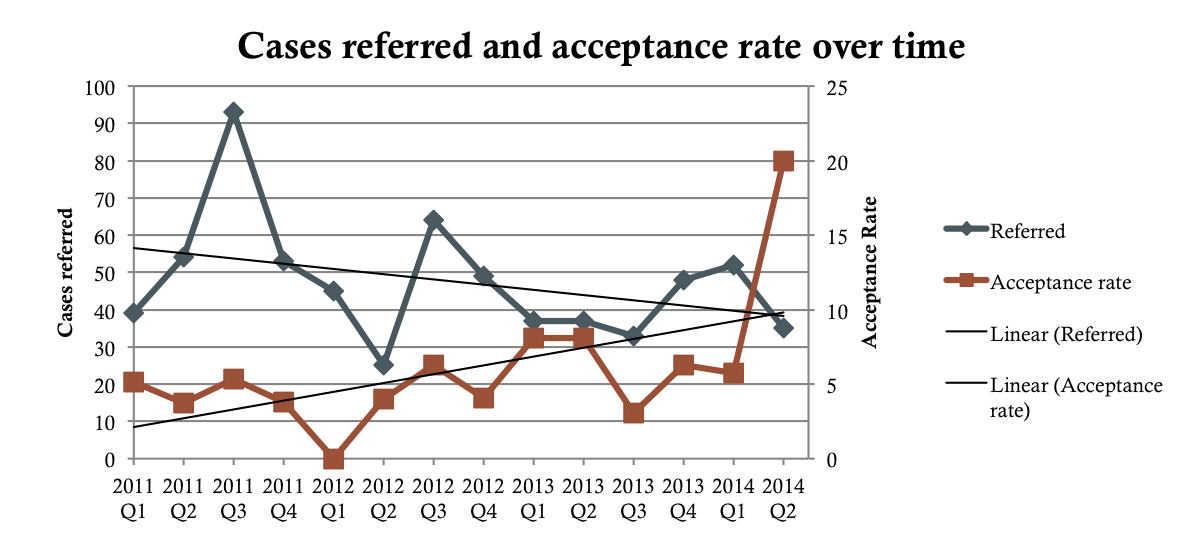 The project, which I am now writing up, studies referral requests and decisions from 2011-2014. This confirms that the acceptance rate for referral requests is very low (as demonstrated by the chart to the left) and that the nature of the alleged violation is not, per se, the relevant indicator of seriousness. Rather, seriousness is determined largely by reference to the potential implications of the decision ‘below’ for consistency, evolution and jurisprudential coherence related to the Convention.

 Professor Fiona de Londras