Referrals to the Grand Chamber of the ECtHR

images-4Over the past year or so I have been working on a small-scale project exploring referrals to the Grand Chamber of the European Court of Human Rights under Article 43 of the Convention.

The project started out with me being interested in why no reasons are given for the refusal to accept a referral request, however it has moved on to concentrate on the concept of ‘seriousness’ as used in the relevant provisions of the Convention and rules of court. The key question that I am concerned with is how we identify which questions are ‘serious enough’ for the Grand Chamber to be convened, bearing in mind that hearing a case before the Grand Chamber involves a substantial investment in time, resources and judicial energies.

Article 43 provides:

  1. Within a period of three months from the date of the judgment of the Chamber, any party to the case may, in exceptional cases, request that the case be referred to the Grand Chamber.
  2. A panel of five judges of the Grand Chamber shall accept the request if the case raises a serious question affecting the interpretation or application of the Convention or the protocols thereto, or a serious issue of general importance.
  3. If the panel accepts the request, the Grand Chamber shall decide the case by means of a judgment.
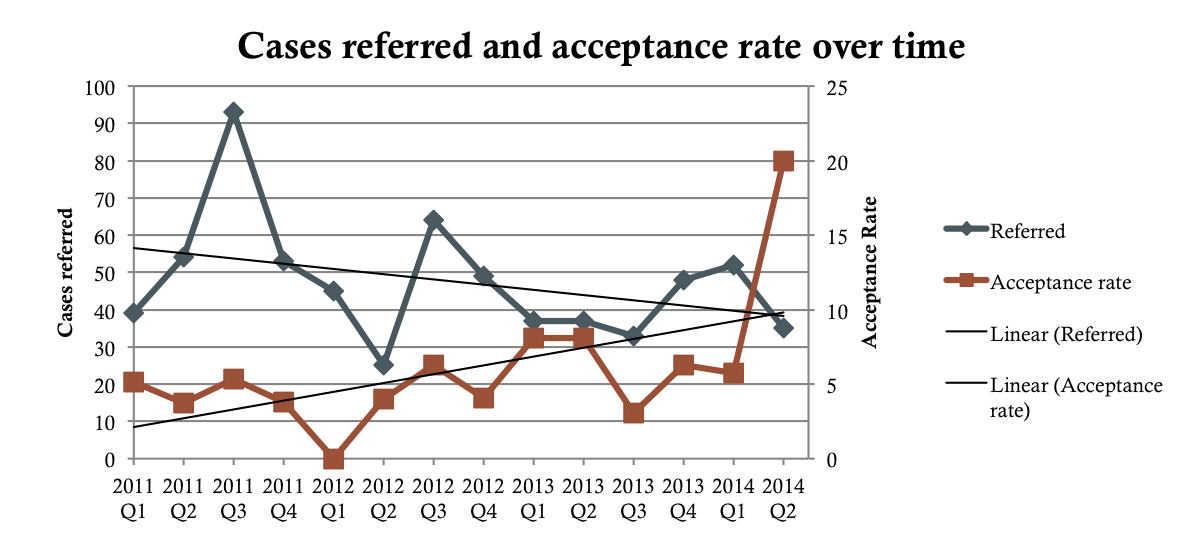
RefsThe project, which I am now writing up, studies referral requests and decisions from 2011-2014. This confirms that the acceptance rate for referral requests is very low (as demonstrated by the chart to the left) and that the nature of the alleged violation is not, per se, the relevant indicator of seriousness. Rather, seriousness is determined largely by reference to the potential implications of the decision ‘below’ for consistency, evolution and jurisprudential coherence related to the Convention.

I presented this as a ‘work in progress’ to the Oxford Human Rights Hub where I am a visiting fellow this year back in February, and the audio from the presentation is available here. There is a very limited amount of scholarship on Article 43 referrals, at least in English. I would be grateful for suggestions from any readers who are aware of relevant work as I move towards finalising this paper.


Interview at KCL on transnationalism, hybridity and counter-terrorism

KCL_GlobalMapMicrosite_logo_V2Earlier this month I was pleased to participate in the KCL transnational law colloquium, where I presented some work on hybridity, counter-terrorism and human rights including and beyond law. After the colloquium I was interviewed on some of the themes that my presentation raised, and that interview is now available (audio file only) on the KCL YouTube stream here.

Genest Memorial Lecture, Osgoode Hall, January 7

osgoodI am delighted to be going to Osgoode Hall Law School in Toronto next month to deliver the Genest Memorial Lecture and a number of seminars, as well as to meet and work with some graduate researchers there and colleagues on the Faculty. My Genest Lecture, the poster for which is attached, will take place at 12:30 on January 7th and is entitled ‘Counter-Terrorism, Transnationalism, and Human Rights’. The abstract is below and the poster for the lecture is attached here.

Much of contemporary terrorism uses the products of globalisation in recruitment, financing and other operations. The transnationalism of terrorism, together with the cross-border connectedness of people, capital, communication infrastructure and politics, have combined so that states now act in concert on a wide variety of issues, one of which is counter-terrorism. In this lecture, Professor de Londras outlines institutional, multi- and bi-lateral forms of transnational counter-terrorism, arguing that ‘external actors’ are deeply involved in directing counter-terrorism. This has serious implications for constitutonalism and human rights, raising questions as to accountability, autonomy, legitimacy and the effective protection of human rights.

New Book: Critical Debates on Counter-Terrorism Judicial Review

9781107053618I am delighted that my new book, co-edited with Fergal F. Davis (UNSW), has now been published by Cambridge University Press. The book, entitled Critical Debates on Counter-Terrorism Judicial Review, features an excellent collection of international scholars who bring their own unique perspectives to the debates about the role and nature of judicial review of counter-terrorist measures, as well as alternatives to judicial oversight (such as enhanced political oversight, enquiries and independent reviewers). This is reflected in the table of contents:

Introduction

Counter-terrorist judicial review: beyond dichotomies, Fergal F. Davis and Fiona de Londras

Part I. Judging Counter-Terrorist Judicial Review
1. Counter-terrorist judicial review as regulatory constitutionalism, Fiona de Londras
2. Counter-terrorism judicial review by a traditionally weak judiciary, Jens Elo Rytter
3. When good cases go bad: unintended consequences of rights-friendly judgments, David Jenkins
4. The rhetoric and reality of judicial review of counter-terrorism actions: the United States experience, Jules Lobel
Part II. Beyond Counter-Terrorist Judicial Review
5. Emergency law as administrative law, Mark Tushnet
6. The politics of counter-terrorism judicial review: creating effective parliamentary scrutiny, Fergal F. Davis
7. Independent reviewers as alternative: an empirical study from Australia and the UK, Jessie Blackbourn
8. Public inquiries as an attempt to fill accountability gaps left by judicial and legislative review, Kent Roach
Part III. Counter-Terrorist Judicial Review in the Political Constitution
9. Rebalancing the unbalanced constitution: juridification and national security in the United Kingdom, Roger Masterman
10. Running business as usual: deference in counter-terrorist rights review, Cora Chan
10. Deference and dialogue in the real-world counter-terror context, Gavin Phillipson
Part IV. Internationalised Counter-Terrorist Judicial Review
11. Counter-terrorism law and judicial review: the challenge for the Court of Justice of the European Union, Cian C. Murphy
12. Post 9/11 UK counter-terrorism cases in the European Court of Human Rights: a ‘dialogic’ approach to rights’ protection or appeasement of national authorities?, Helen Fenwick
13. Accountability for counter-terrorism: challenges and potential in the role of the courts, Helen Duffy.

The book emerged from a workshop generously funded by the British Academy/Leverhulme Trust small grants scheme, and can now be ordered directly from CUP. You can also read the substantive introductory chapter written by myself and Fergal for free through my SSRN page, and my chapter on the Durham repository.